
The Jay Notes.
Three years of texts, courtside conversations, and post-match debriefs between Gabi, Dad, and Coach Jay. Newest first.
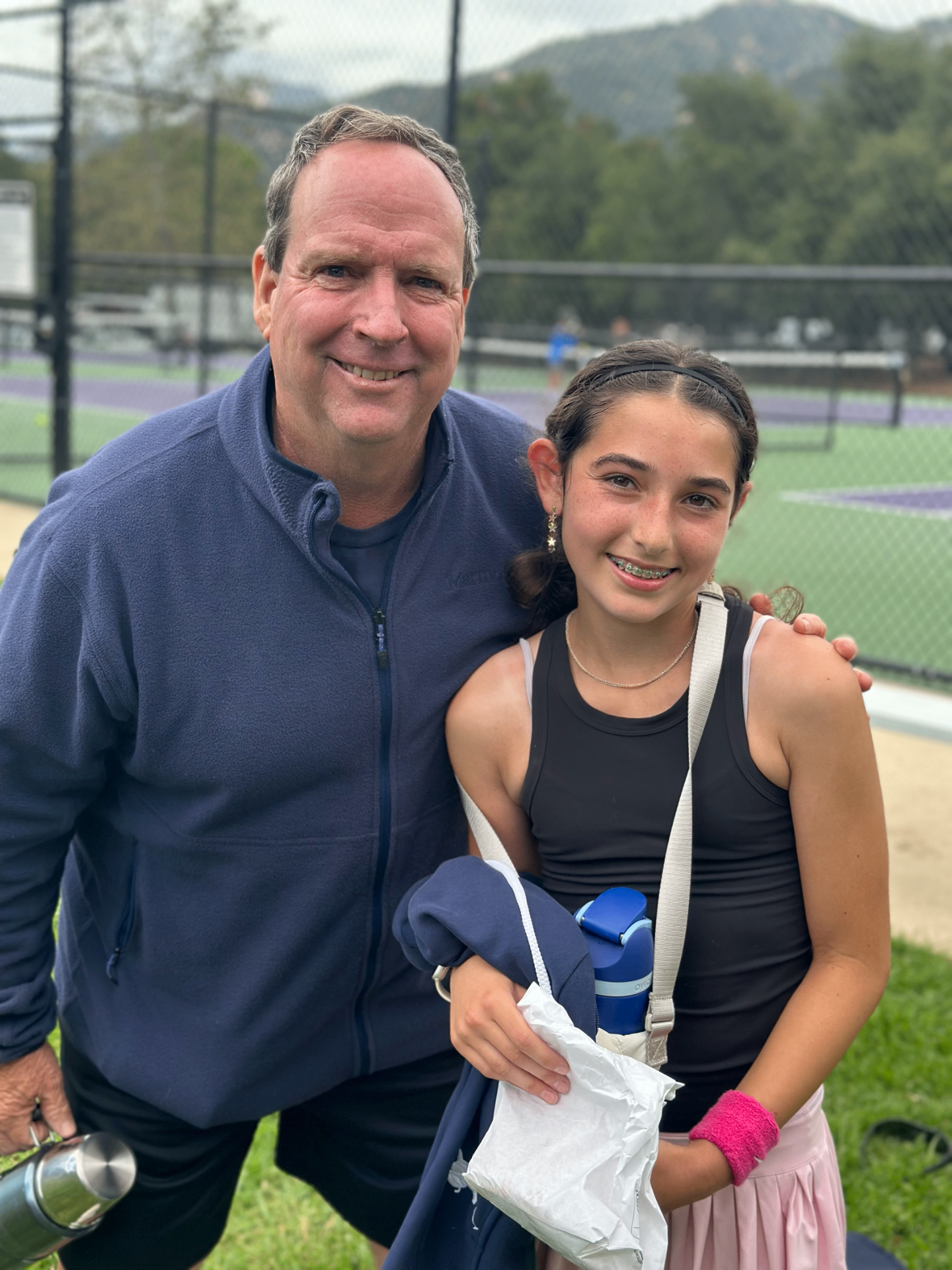
“Upper-body weight is king, legs follow. Hands are always in a position to cause an unbalanced upper body weight that only the legs can fix. That's the flow.”
— Coach Jay
“The ball, the ball, the ball.”
You just want to track that ball and you want the ball back. Hunt the ball. You want to attack that ball. You are always tracking that ball. It’s all about the ball.
— Coach Jay
“Winning is FUN.”
— Steve Rottman
“You need to have Confidence and Concentration and have fun!”
— Dada
After a great matchNote from Coach Jay to Gabi
Good morning 😃! I just wanted to let you know I thought you played amazing yesterday and handled the pressure so well. I know it is no fun to lose but I saw moments of brilliance in a lot of your shots. I'm very excited about your improvement and wanted you to know I was very, very proud of what you achieved yesterday.
So before you throw up ( Jay I lost, I don't want to hear it! Ha) I will start a list of things to improve in our series...
1. Mapping where errors are coming from — her low forehand in front, no pace. Three there.
2. Racket higher on volleys, not below hand. Below is a rally ball, above is angled put-aways. We haven't gotten there yet but we will now for sure.
3. At net, lean forward to make "what is the earliest I can…". Helps put away volleys.
4. High backhand volleys and all volleys in general need a bigger shoulder turn. Again, helps put away a stronger volley.
5. Praise your coach often. Oops — how did that get in there?! Ha.
6. Let's work on the timing of the racket fall on the serve for more power before it gets hard to change.
7. That is it for now. If you really think about it, it's not that much!! Look how far you have come!! Truly awesome sauce. Your flow and footwork were spot on yesterday. I actually saw you waiting for balls on your toes, heels up about 1/8 to 1/4 inch — perfect!!! Like jump rope, just barely off the ground!! And I saw hands as counterweights yesterday!!
Ella played well and we go back to the lab knowing we will get knocked down again, brush it off, learn what went wrong and go fix it. It's actually kinda fun I think. Have a great day and I'll see you Friday!!
Flow & CounterweightJay on hands, weight, and the flow
Someday soon she will get that her power and talent is allowed to flourish with the natural flow of wanting the ball. Spin brings it down. If she gets the flow of in-and-out, just looking to engage the upper-body weight, she will be a beast.
That's how the hands help. They are always in a position to CAUSE an unbalanced upper-body weight that only the legs can fix. That's the flow.
Upper body weight is king, legs follow. Gabi going backwards — still dangerous. Gabi coming forward — very dangerous. Gabi going wide — still dangerous, because the upper body weight is hunting the ball without changing until after impact.
Changeover CuesBetween points & sets
• Stance & Movement: Weight forward, widen stance.
• Footwork: Wide base, hands lead steps.
• Groundstrokes & Volleys: Head still, pick the ball's spot.
• Lifting Balls: Lift with leg push.
• Serve Technique: Head up, leg push.
• Serve Prep: Shadow swing twice for rhythm.
• Serve Return: Ready immediately for return.
• Mindset: Diagnose after the point.
• Breathing: Breathe deep when nervous.
• Fun: Relax and have fun!
Pre-Match Cheat SheetThoughts before the match
Stance & Movement: Keep your weight forward. Widen your stance after serving — and especially when returning. Stay balanced with weight forward throughout the entire point. Use a wide base, check step, and deciding check step, with your hands as counterweights to lead your movement.
Groundstrokes & Volleys: Keep your head completely still. Focus on picking a specific part of the ball to hit for better contact.
Lifting Balls: Lift by pushing off powerfully with your legs for added height and power.
Serve: Keep your head up and push off your legs — don't peek to see if it's in; instead, immediately ready yourself for the return. If you're not feeling your serve or before starting a service game, do two shadow swings to establish flow and rhythm.
Mindset During Play: Avoid evaluating shots in the middle of a point — diagnose and correct only after the point ends.
Breathing for Nerves: Breathe deeply. Inhale through your nose and exhale forcefully a couple of times when you feel tight or nervous.
Overall Approach: Just relax and have fun.
StrategyWeight, ball-shape, and the court
Weight determines so much. With neutral weight or moving backwards off the baseline, a safe-shaped ball with lots of energy out into spin, height and therefore depth is a great play.
However, when weight pulls you inside the baseline to contact the ball, there is less distance to the opponent's baseline — less time, and less distance for spin to be as effective as from farther back.
So when pulled inside the baseline (and here crosscourt is 80% the choice) you definitely want to hit through the court with the ball path much, much lower to be effective. Neutral weight = normal safe shape over the net. A lot of weight forward (contact inside the court) = ball path comes down exponentially.
Work on scrambling inside the service line — calm volley lobs, put-aways, high backhand overheads — and racket-drop timing for more serve speed and spin.
Poetry in MotionJay to Gabi: head still, flow, and a gorgeous serve
Hi Gabi! I just wanted to let you know what I saw you doing today (and other days too!) was absolutely fabulous. Your wide check-steps and their timing… seriously awesome.
Your head still with our little game with exhales was super-duper cool. Life-changing cool. Your flow in and out of the ball today was — pardon my rare use of my English-major background — poetry in motion of pure athleticism. You should have seen it from my side!
Your down-the-lines and crosscourts! The down-the-line scared me a little! And don't get me started on your serve — your serve is gorgeous, and we'll keep working on the timing of the racket drop to make it even better.
I just wanted you to know how proud I am of you and all of your dedication to excellence both on and off the court. You don't need a tournament in my book to tell you anything. I've taught literally thousands of kids and you're already a winner in every way in my book.
Turning PointGabi — you had an amazing practice
Today was a turning point. You found flow — moving in and out of points with clarity, striking clean without second-guessing or evaluating. You trusted your instincts, and they delivered.
What made it click — balance:
• Still head = clean timing
• Exhale on contact = relaxed muscles, more power with less effort
• Leg-driven lift = effortless spin and depth
• Check step with weight forward, wide stance, and arms as counterbalance — so quick and explosive.
And your serve? Best yet. Legs loaded and driving. Head steady. Left arm tall and straight. Tossed on a string and consistent.
You weren't just hitting balls — you were owning your game. Let's carry this energy into tomorrow. You're ready. Sleep well. Tournament mode: on. 🎯🔥
Jump RopeBuilding the legs — patiently
On the jump rope, maybe not more than 8 on the singles, then she can alternate feet for another 10 or so. Singles take a LONG time to build. So much of it is letting time be our friend (long-term goal of 6–9 months) to build the bone mass and cartilage to accept the new stress.
Repetitive every day or every other day is key — but not overworking the calf and foot muscles with long exposure each day. Just enough to stress it a bit, then alternate feet (left-right-left-right) as a warm-down, then back to two feet at once.
The stress on the ankle joint and cartilage will signal the body to beef it up. Those are the quick-fire muscles that will take the most stress. As they build, you can slide on the hard courts no worries. Beast mode.
TournamentsLitmus tests, not verdicts
Absolutely she is ready. We use tournaments as a litmus test — what is working and what isn't. Biggest source of knowledge and motivation, understanding we will still be working on her strokes, footwork, strategy and mapping.
Serve and footwork especially in and out of her backhand now that her legs are stronger. Really fun things left to do — half-volleys (a joke, so easy with the way she hits her volleys now), drop shots from the back court, firming up her wrist on the slice backhand, returning hard serves (super easy and fun, because of her slice strokes à la Fed), running back from the net to re-lob a lob.
SuggestionMake up a three-ball scenario
Then the funnest part for her. Make up a three-ball scenario. Miss them all hard until you figure it out. Hard as in fluid with lifting heavy spin. Hardest thing to do — but only through missing do you figure it out.
Just keep asking for that ball to do what you want over and over. Legs go into overdrive. Then when it works we have a serious player. Hence — don't worry about the wins in a tournament. Worry for your opponents as you figure it out next time you see them!
First question after a match is always: "Do you feel like getting anything to eat or drink?" Let her know how much fun it was just all being there together. If she brings up the match, talk about it honestly — emphasizing how many other kids her age are not putting themselves through this tough situation and how amazing it is that she is.
What's ComingHard flat serves, slice returns, and a complete game
I can't wait (when my ankle feels better) to start hitting her harder flat serves and practice her slice return of serve deep with very few errors. She has the stroke in her — but only the ball will teach her to keep her wrist more quiet and a little firmer on both wings.
Then the girls with big flat first serves get neutralized with her return, which they will not be used to. Then we will have a solid second serve (which wins matches) for her to hold, and very good break potential with both her first-serve returns on a slice that are consistently good and a great topspin-lift second-serve return.
This pushes her into most every rally at least in a neutral position — and with her flow and power with spin (and now movement) she can work herself into a power position in the rally to take it over. If she needs to come forward, all dictated by body weight, she will literally be forced to finish it off coming forward. No decision necessary — upper-body weight is queen.
The Bang Is ComingShe is so close
You've been very patient. We are close to the bang. So hard to say when, but I've done this enough times — I can tell you it's coming. I definitely see pieces of it already.
You heard my laugh yesterday. That's what I was so happy about. Mid-court forehand buried down the line with — first and most important — disguise, height, spin and speed. Zero chance to get it back. A true weapon. I prided myself with it because it's very difficult to attain.
Could you imagine — we get her walking into overheads when possible? Game over getting her off the net. Penetrating slice approaches deep and fairly fast? Disguised topspin forehand drop shots? Topspin lobs, slice lobs. Running three-ball breaks started on both wings — high crosscourt winners. First ball to push them back. Who plans three balls ahead?
Pre-CommitDecide before the ball arrives
Before I learned this, I was just reacting — chasing balls, hoping for outcomes. No plan. No purpose. Then I learned: the pros don't wait to decide. They pre-decide.
Crosscourt rally? Already committed. Short ball? Already attacking. Passing shot? Already visualized. The difference wasn't in their technique — it was in their decisions. They weren't just hitting shots. They were executing plans.
Once I started pre-committing to targets, everything changed. My errors dropped. My confidence grew. I stopped playing defense and started competing.
Running the SeriesTennis is football. Tennis is volleyball.
We are really just beginning how to run the series together. It's football. It's volleyball. You're running plays depending at times on how their defense is holding up.
Where are their errors coming from (mapping)? What was their weight during the last error? Is it a consistent weakness or a one-time error? Spin change is an indicator — if your ball changed their spin in rpms, chances are your ball caused it. Repeat the cycle.
Tennis is so intricate and court IQ is key. She will excel in it all.
Becoming an AthleteThe day she found her weight
Ya — she became an athlete yesterday, by the way she found her weight standing waiting for a ball. Pretty funny that's an indicator, but you can literally see it. I can tell the day it happens. Congratulations Miss Gabi!
As she gets better the left will become dominant on both sides, but especially the forehand. She literally will be able to jump off the court whenever she wants to as the left becomes stronger.
It's a natural progression — then you'll see her right foot pivot naturally more forward like a golf swing as the body asks for more natural power and rotation. Then that foot gets in the air for more power, same foot pivot. I don't teach that until it starts happening. Then we video it to show her it's already there.
VolleysThe most rare sound in tennis
That was a great day on a fantastic court. She is doing fabulous things. I have to say I was getting a little excited about the volleys today.
First day she learned to just try that one wrist up there with weight — and did you hear that sound!? I know the court surface and wall enhanced it, but you first have to have it. She cracked some volleys today, my friend. That's a truly beautiful sound. Most rare sound in tennis.
CoachableFrom a high-school baseball coach
"I really don't wanna hear excuses or this or that or I heard, or yeah but then this happened or I know. Just be coachable. Just take the instruction in. This isn't about being perfect. This isn't about never being wrong. If you don't have enough toughness to be coachable, to take some instruction in — I'm trying to win. I'm trying to help be a part of the win and not the reason why we lost."
A lot of businesses like to hire athletes, because they've learned how to take constructive criticism. It's a great life lesson.